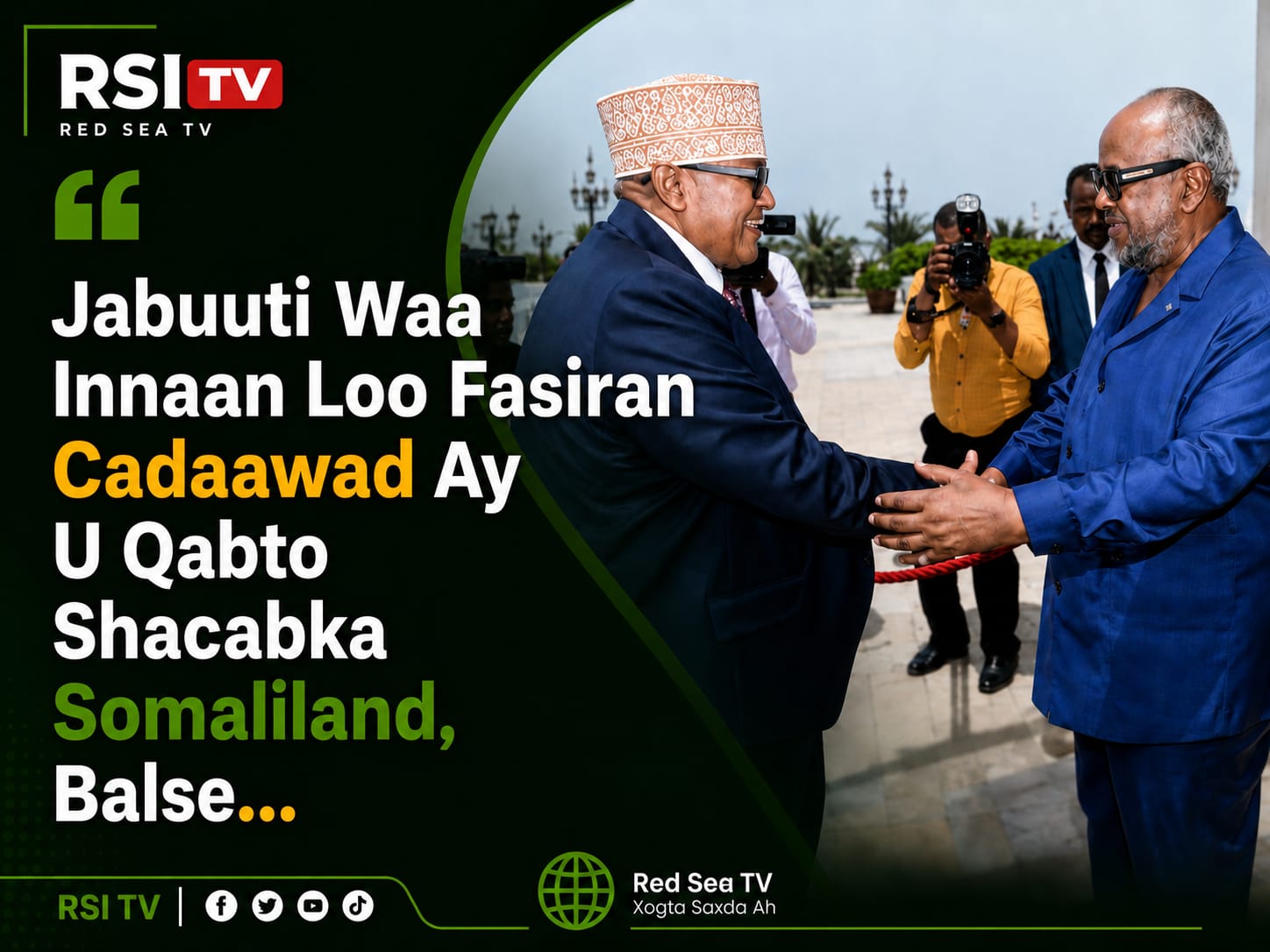
Baraarugtv.com-“An Open Letter to the President of Somaliland
To President Abdirahman Mohamed Abdullahi “Irro”
Dear President Irro,
I am writing to you as a citizen of Djibouti following your recent remarks in The Economist , in which you suggested that Djibouti may be seeking to destabilize Somaliland or may be involved, directly or indirectly, in supporting hostile forces along Somaliland’s borders. You also appeared to suggest that Djibouti’s position may be driven by concerns over Somaliland’s growing regional importance.
These are serious allegations, and they deserve a response—not in the spirit of confrontation, but in the spirit of clarity, truth, and good neighborly relations.
Since the collapse of President Siad Barre’s government, Djibouti has consistently chosen engagement over confrontation in its relations with the Somali people. At a time when Somalia was experiencing profound political fragmentation and instability, Djibouti repeatedly opened its doors to dialogue and reconciliation. The Arta Conference remains perhaps the clearest expression of this policy. By bringing together representatives of Somali society, Djibouti sought to contribute to the restoration of legitimate Somali institutions and to the country’s return to the international community.
Djibouti’s position regarding Somaliland has also been consistent. It recognizes the principles of Somalia’s sovereignty and territorial integrity, in accordance with the longstanding positions of the African Union and the international community. At the same time, this position has never prevented Djibouti from recognizing the distinct political, social, and historical realities of Somaliland or from encouraging dialogue concerning its aspirations. Supporting Somalia’s territorial integrity does not require hostility toward Somaliland or disregard for the legitimate concerns of its people.
Indeed, Djibouti’s actions speak louder than accusations. Over the years, Djibouti has sought to maintain practical and constructive relations with Somaliland. It has established a commercial presence to facilitate trade and economic exchanges and has supported cooperation in areas including administration, telecommunications, and cross-border connectivity. These are not the actions of a state seeking to destabilize its neighbor. They are the actions of a country attempting to preserve channels of communication and cooperation between communities that share centuries of history, family ties, culture, and commerce.
It is therefore difficult to reconcile Djibouti’s record with the suggestion that it seeks confrontation with Somaliland over ports, trade, or regional influence. Djibouti has no interest in turning Zeila, Awdal, or any other part of the region into a theatre of geopolitical rivalry. Such an approach would serve neither Djibouti nor Somaliland, and certainly not the communities that have lived in these areas for generations.
The tensions currently affecting parts of western Somaliland should therefore not be reduced to the actions of an external actor. Local grievances, questions of political representation, clan dynamics, economic interests, and wider regional rivalries all deserve to be examined seriously. Simplifying these complex realities by attributing them primarily to Djibouti risks overlooking the legitimate concerns of the communities themselves and may ultimately deepen the very tensions that all responsible leaders should seek to reduce.
The growing attention surrounding Xeer Ciise, the customary law of the Issa community, following its recognition by UNESCO in December 2024, is another reminder that questions of cultural identity, historical heritage, and community dignity remain deeply significant in the Horn of Africa. In places such as Zeila and Awdal, where communities possess longstanding historical and cultural identities, their concerns deserve to be heard with seriousness and respect. Political disagreements should not become a reason to dismiss or marginalize legitimate cultural and community aspirations.
The same principle should guide our approach to regional economic competition. Djibouti and Ethiopia have developed one of the Horn of Africa’s most important commercial and logistical relationships. Ethiopia’s desire to diversify its maritime access is understandable, just as Djibouti’s interest in protecting its economic position is legitimate. These interests need not be mutually exclusive. The Horn of Africa is large enough for multiple ports, corridors, and economic partnerships. What the region needs is not a competition in which one neighbor’s success is perceived as another’s loss, but a framework in which connectivity and economic growth benefit the region as a whole.
It is in this context that Djibouti views the question of Somaliland’s relations with Israel with particular caution. Any move toward unilateral recognition of Somaliland should be considered in light of the established principles of sovereignty, territorial integrity, and regional stability upheld by the United Nations and the African Union. Djibouti’s position should therefore not be interpreted as hostility toward the people of Somaliland, but as a reflection of its longstanding commitment to the principles governing international relations and African unity.
Mr. President, the Horn of Africa has endured more than enough conflict, suspicion, and political fragmentation. Our peoples have paid a heavy price for the rivalries of political leaders and the competition of external powers. The responsibility of our generation is not to reproduce these divisions, but to manage them with wisdom.
For that reason, I respectfully appeal to you and to the authorities of Somaliland to approach the current tensions with restraint and statesmanship. Where there are grievances, let them be addressed through dialogue. Where there are misunderstandings, let them be clarified through direct communication. And where there are legitimate differences, let them be managed without turning neighboring peoples against one another.
Djibouti has no interest in the instability of Somaliland. A peaceful, prosperous, and stable Somaliland is in Djibouti’s interest, just as a peaceful, prosperous, and stable Somalia is in the interest of the entire region. Our geography, history, and shared communities make us neighbors; they should not make us adversaries.
The Horn of Africa needs fewer accusations and more dialogue, fewer rivalries and more cooperation, and above all, leaders willing to look beyond the politics of the moment toward the long-term interests of their peoples.
Djibouti remains committed to peace, good-neighborly relations, dialogue, and the stability and prosperity of the Horn of Africa.
Respectfully ,
Al-Aghbari
A citizen of Djibouti
August 24, 2026
baraarugnews@gmail.com caarshe7@hotmail.com